

By: Jerry Peters
The blues have always resisted permanence. Long before it was documented, cataloged, or canonized, it existed as something passed from one pair of hands to another, a melody altered by memory, a lyric reshaped by experience, a story that belonged as much to the singer as to the tradition itself. Every generation produces artists who understand this instinctively. They don’t preserve the blues behind museum glass. They continue the conversation.
Robert Johnson was one of those artists.
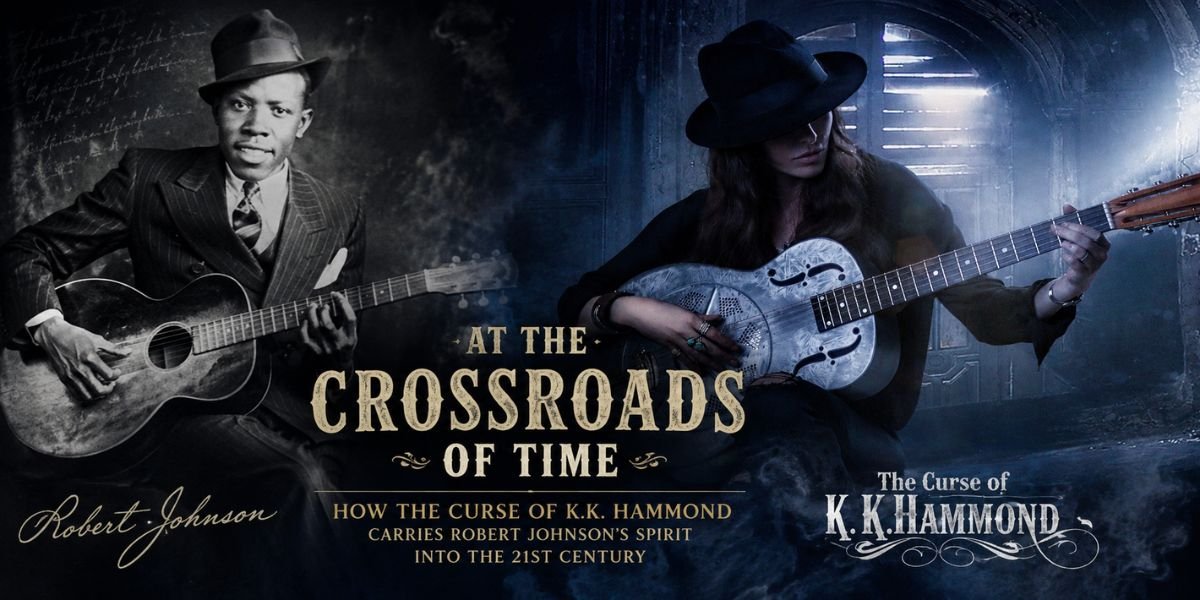
Nearly a century later, so is The Curse of K.K. Hammond.
At first glance, they seem separated by almost everything. Johnson emerged from the Mississippi Delta during the Great Depression, leaving behind fewer than thirty recorded songs before his death at twenty-seven. Hammond lives in rural England, recording in an era where music can circle the globe in seconds. Yet both artists share something deeper than geography or chronology. Each approaches the blues not as a style to imitate but as a language capable of expressing mystery, isolation, longing, and resilience.
Johnson’s mythology has often overshadowed his musicianship. The familiar tale of a bargain made at the crossroads persists because it offers an irresistible explanation for his extraordinary talent. But stripped of folklore, Johnson’s recordings reveal something even more compelling: an artist constantly reshaping traditional material into intensely personal statements. Songs like “Hellhound on My Trail,” “Cross Road Blues,” and “Come On in My Kitchen” sound rooted in Delta convention while simultaneously pointing toward something entirely individual.
The Curse of K.K. Hammond operates from much the same creative instinct.
Her music is unmistakably grounded in Delta blues traditions, the resonator guitar, the slide work, the open tunings, the hypnotic rhythms, but she filters those influences through British folklore, Gothic storytelling, and cinematic atmosphere. Rather than reproducing the sound of the 1930s, she asks what those songs might become if they continued evolving uninterrupted into the present day.
That distinction matters.
Many contemporary blues performers strive for historical accuracy, carefully recreating vintage tones and arrangements. Hammond takes another path. Like Johnson himself, she treats tradition as a foundation rather than a destination. Every recording carries echoes of the past without becoming confined by nostalgia.
Her debut album, Death Roll Blues, demonstrated that philosophy with remarkable clarity. The record introduced audiences to a songwriter equally interested in American Delta traditions and shadowy English landscapes. Collaborations with David & the Devil yielded songs that felt simultaneously ancient and immediate, earning international recognition, including #1 positions on the UK and U.S. iTunes Blues charts and a Top 10 appearance on Billboard’s Blues chart.
Those achievements are noteworthy, but charts tell only part of the story.
What distinguishes Hammond is her commitment to atmosphere. Johnson created vivid emotional landscapes using little more than voice and guitar. Hammond expands that approach into visual storytelling. Her music videos, particularly collaborations with Kaspar “Berry” Rapkin such as “Walk With Me Through the Fire” and “Heart Shaped Box”, extend her songs into carefully crafted Southern Gothic narratives where abandoned roads, candlelight, forests, and weather become characters themselves.
The comparison to Johnson becomes especially striking in Hammond’s interpretation of “Ain’t No Grave.”
Although the song originated with Brother Claude Ely rather than Johnson, Hammond approaches it with the same fearless instinct that defined Johnson’s recordings. She doesn’t attempt historical reconstruction. Instead, joined by David & the Devil and Rapkin, she uncovers the emotional core beneath the familiar lyrics. The result feels timeless rather than contemporary or nostalgic,a performance that recognizes blues music has always been transformed by those willing to inhabit it completely.
Johnson’s greatest recordings often blurred the line between sacred and secular, hope and despair. Hammond inhabits similar territory. Her work embraces ghosts, folklore, mortality, redemption, and spiritual searching without ever reducing them to theatrical devices. The darkness in her music exists because the blues has always acknowledged darkness. Its purpose is not to celebrate suffering but to survive it.
There is another parallel worth noting: independence.
Johnson spent much of his brief career traveling from town to town, existing outside conventional structures and leaving behind an influence that far exceeded his commercial success during his lifetime. Hammond has likewise built her career on her own terms. Living a deliberately secluded life in the English countryside, she has cultivated an artistic identity largely untouched by commercial trends. That independence lends authenticity to her work; it feels discovered rather than manufactured.
Perhaps that is why Hammond’s music resonates so strongly. It reminds listeners that the blues has never belonged to a single place or period. Its emotional truths are portable. They crossed oceans long ago and continue finding new voices willing to carry them forward.
Robert Johnson did not leave behind a blueprint. He left behind possibilities.
The Curse of K.K. Hammond understands that distinction. Rather than chasing Johnson’s ghost, she walks beside it, not as an imitator, but as another traveler moving through the same landscape, listening for old echoes and answering them with a voice unmistakably her own.
That is how traditions endure. Not by standing still, but by finding artists courageous enough to let them live again.