


By: Faye Meyer
“I watched a competitor acquire a mobile housing community last year, immediately raise lot rents by $150 per month, and lose 22% of residents within six months. Their spreadsheet showed instant NOI growth. The reality: eighteen months of chaos, constant turnover, and operational losses that erased the paper gains.
Most real estate operators optimize for rent growth; we optimize for resident retention. This contrarian approach defies conventional wisdom, but twenty years investing in workforce housing taught me something critical: the math proves retention economics outperform aggressive rent extraction every time.” – Walter Johnson (Founder & CEO – Sonos Capital)
The Hidden Cost of Turnover
The Apartment Model Depends on Churn
Traditional apartments operate under the 50% annual turnover rate as a built-in assumption. Operators expect 18-month average lease terms and absorb turnover costs, vacancy loss, marketing expenses, make-ready work, and tenant screening as part of operating reality. This model works because renters can move easily. Pack boxes, hire movers, sign a new lease across town. The business model accommodates constant churn.
MHC Economics Work Differently
Mobile housing community economics operate under entirely different principles. Moving a mobile home costs $8,000 to $25,000. Residents own their homes, 97% homeownership rate, making them homeowners, not renters.
The result:
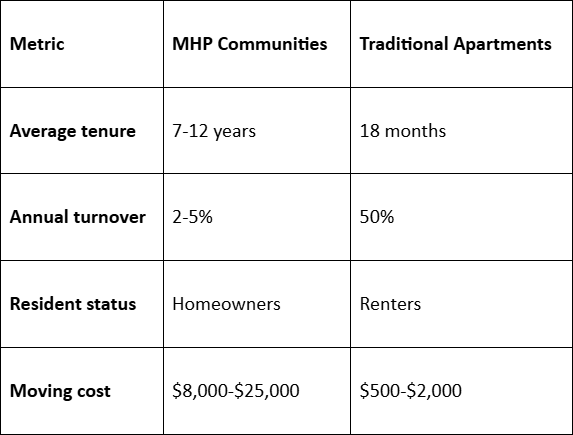
Retention isn’t a bonus in this business model. It’s the foundation.
What Turnover Actually Costs
When a resident leaves a mobile housing community, operators face costs apartment landlords never consider:
- Vacancy loss: Empty lots generate zero revenue until a new homeowner moves in (average 3-6 months)
- Marketing costs: Finding qualified buyers or renters for available lots
- Screening and approval: Background checks, income verification, references
- Home removal risk: If residents abandon homes, disposal costs range from $3,000 to $8,000
- Lost institutional knowledge: Long-term residents report issues early, welcome new neighbors, and maintain informal community standards
- Reputation damage: High turnover signals instability to prospective residents
At one Phoenix-area property we evaluated, the previous owner raised rents aggressively and experienced 18% turnover in one year. Lost revenue from vacant lots exceeded the rent increases collected. The math didn’t work, but the operator didn’t calculate full turnover costs.
The Retention-First Strategy
We built our operational model around a principle I learned managing my first property in 2008: keep good residents happy, and economics take care of themselves.
Improvements First, Rent Later
Through our BuyYourPark.com platform, we acquire properties at 60-80% occupancy with rents 30-50% below market. During the first 6-12 months, we focus on visible improvements: repaved roads, upgraded lighting, enhanced safety features, and modernized common areas. We will not implement rent increases during this stabilization period. Residents experience value before any price adjustments.
This builds trust before optimizing revenue. It’s a contrarian move, we deliberately delay income to build the foundation for sustainable growth. Most operators do the opposite: raise rents immediately, make cosmetic improvements later if residents complain.
Gradual, Predictable Rent Alignment
After improvements become visible, we implement gradual rent alignment over several years. Increases remain predictable so residents can budget accordingly. We always maintain a 30-50% discount versus traditional apartment rents in the same market.
Communication matters: residents know what’s coming, why increases are happening, and when adjustments take effect. No shock $200 monthly rent hikes that force working families to leave. At one property, we held community meetings every quarter for two years, explaining improvement timelines and rent trajectories. Resident satisfaction scores increased even as rents gradually rose to market levels.
The Compounding Effect
Years 1-2: Lower revenue than aggressive operators achieve, but occupancy stabilizes, and resident trust builds.
Years 3-5: Retention economics compound, no turnover costs, consistent rent collections at 95-97% collection rates, operational efficiency gains.
Years 5+: Communities run smoothly with established resident bases. Long-term residents become informal property managers, reporting maintenance issues early and helping new neighbors acclimate.
This timeline explains why we typically hold properties 5-7 years. The full value cycle requires patience that 3-year flip operators don’t have.
Why Retention Beats Rent Extraction
The Math: Side-by-Side Comparison
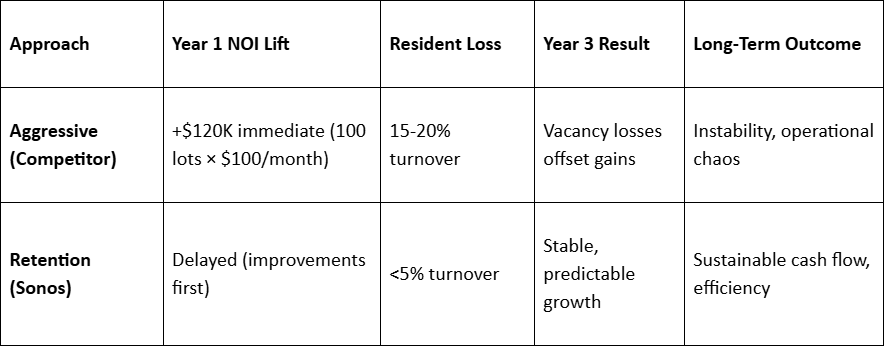
The aggressive approach shows impressive Year 1 numbers. By Year 3, turnover costs, vacancy losses, and community disruption erase the gains. Our approach sacrifices short-term NOI for long-term stability.
What Investors Actually Want
Investors say they want maximum returns. What they actually want: predictable cash flow, low operational risk, and sustainable growth trajectories. Retention delivers this better than extraction.
Stable communities mean:
- Fewer emergency repairs (long-term residents maintain homes better)
- Lower management costs (less turnover admin, fewer conflicts)
- Consistent quarterly distributions (no vacancy surprises)
- Stronger exit positioning (institutional buyers pay premiums for stable assets)
There’s a natural alignment between resident stability and investor outcomes. We just make it explicit rather than accidental.
The Mission-Returns Connection
Treating residents well isn’t charity, it’s economics. Families who feel valued pay rent on time. Well-managed communities achieve 95-97% collection rates, compared with industry averages of 85-90%. Stable neighborhoods require less management intervention. Better outcomes emerge for everyone: residents get quality housing they can afford, investors get reliable returns, operators run efficient properties.
My board positions with the Arizona Mobile Housing Association and Mesa’s Affordable Housing Committee reinforce this daily: communities that prioritize resident stability outperform those focused purely on extraction.
The Long Game
Why Quick Operators Miss This
Operators with 3-5 year hold periods can’t wait for retention economics to compound. They need an immediate NOI lift for quick exits to institutional buyers or REITs. We hold properties for 5-7 years, allowing the full value-creation cycle to play out. Patience becomes a competitive advantage when you understand that sustainable communities take time to build.
In markets like Phoenix, Las Vegas, and Albuquerque, where we focus exclusively, this long-term approach compounds faster because population growth and housing affordability gaps create sustained demand. Geographic specialization lets us see these patterns clearly.
Retention as Competitive Moat
Once residents trust management, community stability becomes self-reinforcing. Long-term residents mentor new arrivals. Community reputation attracts quality residents when turnover does occur. Relationships with local officials strengthen as they observe stable, well-run neighborhoods.
This competitive moat can’t be replicated with capital alone; it requires time, consistent execution, and genuine commitment to operational excellence. The 70% of communities still owned by mom-and-pop operators can’t achieve this systematically. National operators spreading across 20-30 states can’t maintain the local relationships that matter. Regional focus with patient capital creates an advantage.
The Bottom Line
Retention economics aren’t soft or idealistic; they’re hard math verified across twenty years and multiple economic cycles. When you understand the true cost of turnover in mobile housing communities, the contrarian approach becomes obvious. We optimize for what actually drives long-term value: people choosing to stay.
The operators chasing immediate rent bumps are building spreadsheets. We’re building communities. One generates short-term NOI. The other generates sustainable value. I’ve watched both approaches play out hundreds of times. Stability wins.
If you’re evaluating mobile housing investments, ask operators about their resident retention rates and average tenure. Those numbers tell you whether they’re extracting value or creating it. Our approach takes longer, requires more discipline, and produces better outcomes for everyone involved. That’s not idealism, that’s just understanding the business model.
For more information, visit www.sonoscapital.com.
Disclaimer: The information provided in this article is for educational and informational purposes only. It is not intended as investment advice and should not be relied upon as such. While the strategies discussed may offer insights into investment practices, individual results may vary based on market conditions and personal circumstances.