

One of the most effective tools in a line-of-credit application costs nothing and takes twenty minutes to produce: a short cover letter. Few owners bother. Yet a reviewer who understands your business in sixty seconds can move your file faster than one who has to piece the story together from statements.
Here’s a sample letter from a fictional wholesale bakery supplier. We’ve taken it apart paragraph by paragraph, explaining what each passage does and which qualification standards it addresses. Use it as a model for your own, but include only facts that are true for your business.
Paragraph One: Who You Are
“Crestview Baking Supply LLC has served independent bakeries and cafés throughout central Ohio since 2020. We operate from one leased warehouse, employ nine people, and are in good standing with the Ohio Secretary of State.”
What this paragraph accomplishes: It answers the first eligibility questions quickly. Most online providers look for a certain time in business, often six months to two years. Banks usually want two years or more. Good standing is a simple but real requirement, and a delinquent state filing can stop an application immediately.
Before you write your version, verify:
- Your formation date, as shown on state records
- Your current standing with your state
- That your legal name matches your EIN and bank account
Paragraph Two: Your Revenue
“Our average monthly bank deposits over the past six months were $128,000. Revenue rose 11% from the same period last year. November and December typically run about 30% above average.”
What this paragraph accomplishes: It addresses the central test for fast credit lines, which is sufficient and predictable income. Mentioning seasonality in advance prevents a reviewer from misreading a strong or weak month.
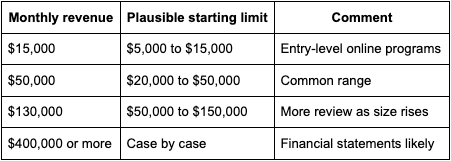
Keep the figure honest by removing transfers, refunds, and any loan proceeds from your deposit average. Typical limits depend on revenue, as the following table suggests. Actual results will vary by provider.
An overview such as Fundivi credit line qualifications can show you what a provider might request at each stage.
Paragraph Three: Your Reason for Wanting the Line
“We are requesting a $60,000 revolving line. Our restaurant customers pay on 30-day terms, while our flour and sugar vendors require payment within 10 days. The line will cover that 20-day gap, especially during the holiday peak.”
What this paragraph accomplishes: It shows a real timing need and demonstrates that draws will be repaid from identifiable receivables. Providers look more favorably on a line tied to a repeatable cycle than on a vague plan to “have extra cash available.”
Notice the size of the request relative to monthly deposits: less than half. This gives the reviewer room to say yes quickly.
A related publication that surveys funding providers known for fast approval can offer a look at how various companies handle speed. Use it as background while you decide on the amount and structure that suit your cycle.
Paragraph Four: Your Existing Obligations
“We have one equipment loan with a monthly payment of $1,420 and a balance of $38,000. We have no merchant cash advances or other short-term financing.”
What this paragraph accomplishes: It provides the very information reviewers look for on your statements. Being transparent makes you look organized and removes a likely question.
Lines of credit are especially sensitive to existing short-term debt, because several daily payments can suggest financial strain. A common rule of thumb is that the less of your monthly deposits already goes toward debt payments, the better.
If you’ve got something awkward to disclose, disclose it anyway and explain your plan: “We have one advance with a remaining balance of $9,000, scheduled to be paid in full by March.”
Paragraph Five: Your Credit and Records
“The majority owner’s credit score is in the low 700s. There are no tax liens or judgments against the company. A late payment in 2023 resulted from a billing error that has since been corrected.”
What this paragraph accomplishes: It confronts credit and public records directly. Bank lines usually require strong personal credit, while some online providers accept lower scores with lower limits and higher fees. Eligibility standards keep changing too, as you’ll see in this AP release on business funding credit requirements, but a policy on eligibility doesn’t guarantee an approval for any particular applicant.
Providing a brief explanation of any past problem keeps a single blemish from defining your application. Keep it factual, without excuses.
Paragraph Six: What’s Attached
“Enclosed are six months of complete business bank statements, the owner’s identification, our EIN letter, our articles of organization, our 2024 and 2025 business tax returns, and a current accounts receivable aging report. I’m available by phone all day at the number below.”
What this paragraph accomplishes: It signals that your file is complete and that you’re available. For a one-day decision, being reachable can matter as much as any financial metric.
Your attachments should generally include:
- Complete bank statements for three to six months or more
- Identification for owners above the provider’s threshold
- EIN and formation documents
- A recent tax return for larger lines
- A profit and loss statement and balance sheet for larger requests
- A receivables aging report, if you sell on credit
The Letter’s Silent Seventh Paragraph: Timing
The letter can’t control the clock, but you can. Submit early in the business day and early in the week, and pick up whenever the provider calls. Remember that there are several stages between a decision and available money:
- Decision: Often within minutes to a day for simple online lines
- Contract and verification: Commonly a few hours
- Bank account linking: Can be immediate, or take longer
- First draw: Often the same day or the next business day
So when a provider says “24 hours,” ask whether it refers to approval or actual access to money.
Reading the Answer
Comparing offers takes only a few minutes when you focus on the following items: the advertised rate, draw fees, monthly or annual fees, the repayment schedule for each draw, whether repaid amounts revolve, personal guarantee terms, and the provider’s rights to reduce or freeze the limit.
Educational resources, including the MerchantGuidance.com credit line explainer, may help you decode these terms. Still, nothing replaces reading the contract you’re being asked to sign.
If you’re denied, ask for the specific reason. Lenders often must provide or make available a statement of reasons for adverse action on business credit applications, and the answer can show you what to fix before you apply again.
Writing Your Own Letter
Keep yours to a single page and follow this order:
- Who you are and how long you’ve operated
- Your average deposits and any seasonality
- How much you want and why, tied to a repeating need
- All existing debts
- Credit and any issues to explain
- What’s enclosed and how to reach you
Don’t exaggerate. A reviewer will compare each statement to your records, and an inaccurate letter can do far more harm than having no letter at all.
Frequently Asked Questions
Is a cover letter required?
Rarely, particularly with online forms. Where there’s an upload option or an assigned representative, a short letter can still save time.
What’s the minimum time in business?
Online providers may accept six months to a year. Banks typically want two years or more.
Can I qualify with mediocre credit?
Possibly with online lenders, usually at lower limits and higher costs. Secured lines are another option.
Do I need collateral?
Not always, though a personal guarantee and general lien are common even with unsecured lines.
How much can I ask for?
Ask for an amount you can justify by your cash cycle and deposits. Requesting too much can lead to a slower review or a decline.
Can I get access the same day?
For some simple online lines, yes. Verification, bank linking, and transfer timing can add a day or more.
Will I need tax returns?
Not always for smaller lines. Larger limits and bank products usually require them.
Can I qualify as a sole proprietor?
Often, if you have a dedicated business bank account and documented revenue.
Should an accountant write the letter?
You can write it yourself, but having an accountant check your figures is useful.
Disclaimer: This article is for informational purposes only and does not constitute financial or legal advice. Business line of credit eligibility, rates, fees, and approval timelines vary by provider. Faster approval or funding is not guaranteed. Business owners should carefully review all financing terms and consult a qualified financial professional before making decisions.