

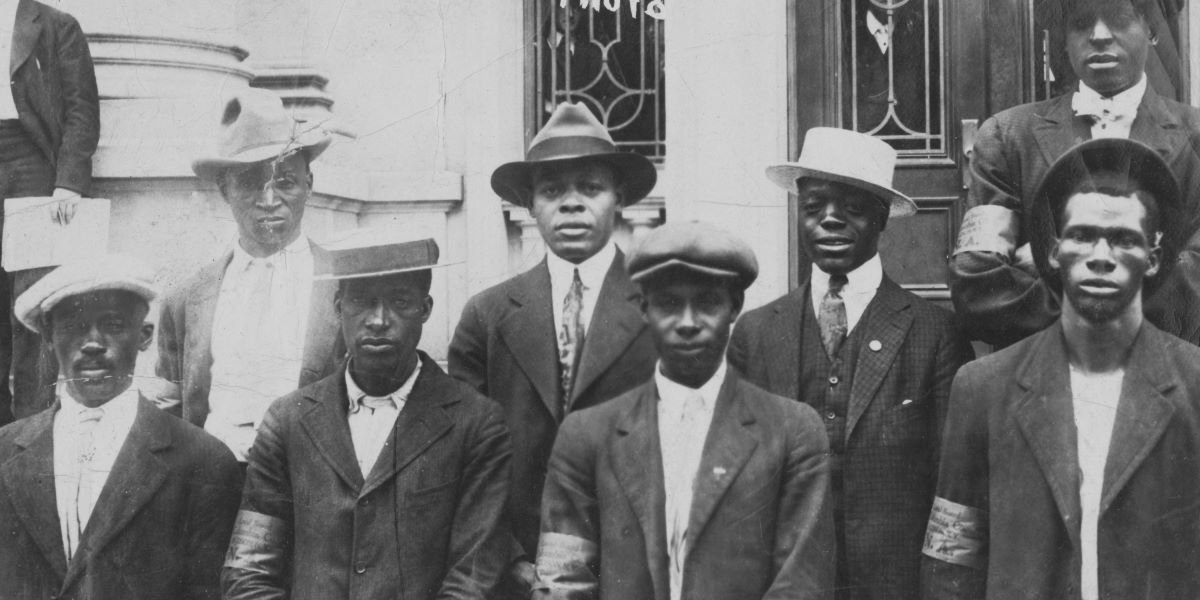
Between 1910 and 1970, approximately six million Black Americans left the rural South for cities in the North, Midwest, and West, making the Great Migration one of the largest internal population movements in United States history. In 1910, roughly 90 percent of all Black Americans lived in the South, the majority in rural agricultural areas. By 1970, that share had dropped to just over half, and eight in ten Black Americans lived in metropolitan areas. One in four lived in just five cities: New York, Chicago, Philadelphia, Los Angeles, or Detroit. The migration did not just relocate people. It built new economies, created new cultural movements, generated new political power, and redrew the demographic map of the country in ways that still define American life.
Key Takeaways
- The Great Migration moved roughly six million Black Americans from the rural South to cities across the North, Midwest, and West in two distinct waves: 1910 to 1940 and 1940 to 1970.
- Between 1910 and 1920 alone, the Black population of New York grew 66 percent, Chicago’s grew 148 percent, Philadelphia’s grew 500 percent, and Detroit’s grew 611 percent.
- Black-owned businesses across the country jumped from roughly 5,000 to 70,000 during the first wave of migration as new urban population centers created concentrated consumer markets.
- The migration produced the Harlem Renaissance, transformed Southern blues into Chicago electric blues and jazz, sent the first Black congressman of the 20th century to Washington from Chicago, and laid the demographic groundwork for the civil rights movement.
- In the second wave, Los Angeles’s Black population grew from 63,700 in 1940 to 763,000 by 1970 as defense industry jobs and West Coast manufacturing drew millions to new destinations beyond the traditional northern corridor.
Jim Crow, Sharecropping, and Racial Violence Drove Millions Out of the South
The conditions that produced the Great Migration were not subtle. By the early 20th century, the vast majority of Black Southerners were locked into a system of racial subjugation that operated through law, economic control, and violence simultaneously. Jim Crow statutes mandated racial segregation in public spaces, schools, transportation, and housing. The sharecropping system, which replaced formal slavery with a cycle of debt-driven farm labor, kept Black families tied to land they did not own and trapped in poverty they could not escape. Literacy tests, poll taxes, grandfather clauses, and outright intimidation eliminated Black voting power across the former Confederacy.
Lynching functioned as the system’s enforcement mechanism. Between 1882 and 1968, the NAACP documented 4,743 lynchings in the United States, a substantial majority of which targeted Black men and women in the South. The threat of extrajudicial violence was not abstract for the families who eventually left. The Arthur family of Paris, Texas, arrived in Chicago in 1920 after two family members were murdered in a lynching, a story the Chicago Defender published on its front page alongside a photograph of the displaced family at the Polk Street train station.
Economic conditions tightened the pressure. Most Black farmers in the South did not own the land they worked. Crop failures, boll weevil infestations that devastated cotton production across the Deep South, and the deliberately exploitative accounting practices of white landowners left Black sharecropping families with little to show for a year’s labor. Against this backdrop, the pull factors from the North did not need to be extravagant to be decisive. A factory job paying steady wages in Chicago, Detroit, or Pittsburgh represented a concrete improvement over sharecropping in Mississippi, Alabama, or Georgia.
The First Wave Carried 1.5 Million People to Northern and Midwestern Cities Between 1910 and 1940
The first major phase of the Great Migration accelerated when World War I simultaneously cut off European immigration and created a wartime labor shortage in the industrialized North. Factories, steel mills, meatpacking plants, and railroads needed workers, and Black Southerners answered. Between 1910 and 1930, roughly 1.5 million Black Americans relocated, with the primary destinations clustered in the Northeast and Midwest: New York, Chicago, Philadelphia, Pittsburgh, Detroit, Cleveland, and St. Louis.
Black newspapers played a direct role in organizing and encouraging the movement. The Chicago Defender, founded by Robert S. Abbott, published train schedules, employment advertisements, housing listings, and firsthand accounts from migrants who had already established themselves in northern cities. The paper circulated widely across the South, passed hand to hand in barbershops, churches, and rail depots. The Pittsburgh Courier, the Amsterdam News in New York, and The California Eagle in Los Angeles performed similar functions for their respective cities. These publications did not merely report on the migration. They actively recruited for it, making the case in editorial language that leaving the South was a practical and moral imperative.
The population shifts were sharp and fast. Between 1910 and 1920, Chicago’s Black population more than doubled. Detroit’s grew by 611 percent in the same decade. New York’s rose 66 percent. In the same period, Black-owned businesses across the United States increased from approximately 5,000 to 70,000, as the concentration of Black consumers in urban centers created markets that had not previously existed at that scale. The South Side of Chicago, Harlem in Manhattan, and the Black Bottom neighborhood in Detroit became economic and cultural centers in their own right, with their own commercial districts, professional classes, and civic institutions.
Harlem, Bronzeville, and the Cultural Movements the Migration Made Possible
The Great Migration did not just move people. It created the conditions for cultural production that would define 20th-century American art, music, and literature. Harlem, a neighborhood at the northern end of Manhattan that had been predominantly white, housed an estimated 200,000 Black residents by the 1920s. The density and energy of that population produced the Harlem Renaissance, a movement that generated breakthroughs in Black literature, visual art, theater, music, and intellectual life that resonated well beyond the neighborhood.
Writers including Langston Hughes, Zora Neale Hurston, Claude McKay, and Countee Cullen published work that articulated a new Black identity rooted in pride, self-determination, and artistic ambition. The movement was not confined to literature. Jazz and blues musicians who had carried the musical traditions of the Mississippi Delta, the Louisiana bayou, and the Georgia Piedmont northward adapted those forms to urban audiences and urban instruments. Chicago’s contribution was particularly transformative: Southern acoustic blues became electrified on the South Side, a shift that produced an entirely new genre, Chicago electric blues, which in turn laid the foundation for rock and roll.
Chicago’s Bronzeville neighborhood, stretching along the South Side, became a parallel cultural capital often called the Black Metropolis. The Chicago Renaissance of the 1930s and 1940s produced writers like Richard Wright, Gwendolyn Brooks, and Margaret Walker, and the neighborhood’s commercial and entertainment district along 47th Street and South Parkway anchored a thriving Black economy. The cuisine, church traditions, community associations, and family networks that migrants carried from Mississippi, Arkansas, and Tennessee embedded themselves in the fabric of Chicago’s South Side in ways that remain visible decades later.
Political Power Followed Population
In the Jim Crow South, Black political participation was systematically suppressed through legal and extralegal means. In the cities of the North and Midwest, Black migrants could vote. The political consequences of that shift were immediate and cumulative.
In 1928, Oscar De Priest, who had been born in Alabama and spent 20 years building a political career in Chicago, won election to the United States House of Representatives. De Priest was the first Black member of Congress in the 20th century and the first ever elected from a northern state. His election was a direct product of the demographic shift the Great Migration had created: enough Black voters concentrated in a single congressional district to send a Black representative to Washington.
The pattern repeated and expanded over the following decades. Adam Clayton Powell Jr. won his congressional seat in Harlem in 1945. Charles Coles Diggs represented Detroit starting in 1955. These electoral achievements were not isolated events. They were built on the organizing capacity of urban Black communities, the civic infrastructure of Black churches and fraternal organizations, and the voter registration drives that the NAACP, the National Urban League, and local political clubs sustained across northern cities. By the 1960s, the political base that the Great Migration had built in the North was a critical support structure for the civil rights movement, providing funding, organizational capacity, and congressional allies for legislative campaigns that culminated in the Civil Rights Act of 1964 and the Voting Rights Act of 1965.
The Second Wave Was Larger, Faster, and Reached the West Coast
The second phase of the Great Migration, spanning from 1940 to 1970, was substantially larger than the first. Roughly 5 million Black Americans left the South during this period, driven by the wartime defense economy and the continued mechanization of Southern agriculture that eliminated sharecropping jobs by the hundreds of thousands. The destinations broadened significantly. While New York, Chicago, Philadelphia, and Detroit continued to absorb large numbers of migrants, the second wave pushed heavily westward for the first time.
Los Angeles became one of the defining destinations of the second wave. The city held more than $11 billion in wartime defense contracts, and the automobile, rubber, steel, and shipbuilding industries needed workers. The Black population of Los Angeles jumped from 63,700 in 1940 to 763,000 by 1970, transforming neighborhoods like Central Avenue, Watts, and Compton into established Black communities with their own commercial corridors, cultural institutions, and civic organizations. San Francisco, Oakland, Seattle, and Portland also received significant numbers of Black migrants during this period, establishing West Coast Black communities that had been negligibly small before the war.
Between 1940 and 1970, roughly 80 percent of all growth in the Black population nationwide occurred outside the South. The states with the largest Black populations shifted accordingly. In 1910, the states with the highest number of Black residents were Georgia, Mississippi, and Alabama. By 1970, the top three were New York, Illinois, and California. The geography of Black America had fundamentally reordered itself in a single lifetime.
The Migration’s Legacy Endures in the Institutions It Built
The Great Migration did not end with a single event or policy change. It tapered through the 1970s as conditions in the South began to improve following the civil rights movement’s legislative victories, and as deindustrialization in the Rust Belt eroded the factory economies that had drawn migrants north in the first place. Detroit, Pittsburgh, Cleveland, and other heavily industrialized northern cities lost manufacturing jobs at a pace that devastated the neighborhoods Black migrants had built, creating a new set of economic challenges that replaced the old ones.
Since the 1970s, demographers have documented a reverse migration, as upwardly mobile Black professionals and retirees have moved from northern and western cities back to the South, drawn by lower costs of living, warmer climates, growing metropolitan economies, and family connections that never fully severed. Atlanta, Houston, Dallas, Charlotte, and the Research Triangle in North Carolina have become primary destinations for this New Great Migration, echoing and inverting the pattern that began more than a century ago.
The institutions the original migration created, however, remain embedded in the cities it built. The churches, civic organizations, business districts, artistic traditions, culinary cultures, and political networks that Black migrants established in Harlem, on Chicago’s South Side, in Detroit’s neighborhoods, and across Los Angeles did not disappear when the migration slowed. They evolved, adapted, and continued to shape the civic and cultural life of those cities. The Great Migration produced the Harlem Renaissance, the Chicago Blues, Motown, the modern jazz canon, a generation of Black elected officials, and the urban demographic base that powered the civil rights movement. Every major American city that received significant numbers of Black migrants during the 20th century carries the imprint of that movement today.
FAQs
How Many Black Americans Left the South During the Great Migration?
Approximately six million Black Americans relocated from the rural South to cities in the North, Midwest, and West between 1910 and 1970. The migration occurred in two phases: roughly 1.5 million people moved between 1910 and 1940, and approximately 5 million more followed between 1940 and 1970. The second wave was substantially larger and extended to the West Coast, particularly Los Angeles, San Francisco, Oakland, and Seattle.
What Caused the Great Migration?
The migration was driven by a combination of push and pull factors. In the South, Jim Crow laws enforced racial segregation, the sharecropping system trapped Black families in poverty, and racial violence including lynching created constant threat. In the North and West, wartime labor shortages during both World Wars opened industrial jobs that paid significantly more than agricultural work. Black newspapers like the Chicago Defender actively encouraged migration by publishing job listings, train schedules, and firsthand accounts from people who had already moved.
Which Cities Received the Largest Numbers of Black Migrants?
During the first wave (1910 to 1940), the primary destinations were New York, Chicago, Philadelphia, Pittsburgh, Detroit, Cleveland, and St. Louis. During the second wave (1940 to 1970), those cities continued to absorb migrants, but Los Angeles, San Francisco, Oakland, Seattle, and Portland became significant new destinations as defense industry jobs drew millions westward. By 1970, one in four Black Americans lived in New York, Chicago, Philadelphia, Los Angeles, or Detroit.
What Cultural Movements Did the Great Migration Produce?
The concentration of Black populations in northern and western cities created the conditions for transformative cultural movements. The Harlem Renaissance of the 1920s and 1930s produced breakthroughs in Black literature, visual art, theater, and intellectual life. Chicago’s South Side became the birthplace of electric blues and a center for Black literary production during the Chicago Renaissance. Jazz evolved and expanded through urban clubs and recording studios in New York, Chicago, Kansas City, and Detroit. The Motown sound emerged from Detroit’s migrant community in the 1960s.
What Is the “New Great Migration” Back to the South?
Since the 1970s, demographers have documented a reversal of the original migration pattern, as Black Americans have increasingly moved from northern and western cities back to the South. Atlanta, Houston, Dallas, Charlotte, and the Research Triangle in North Carolina are among the primary destinations. The reverse migration is driven by lower costs of living, growing metropolitan job markets, family ties, and improved social conditions in the post-civil rights South. By the 2020s, the South once again held the majority of the nation’s Black population.