

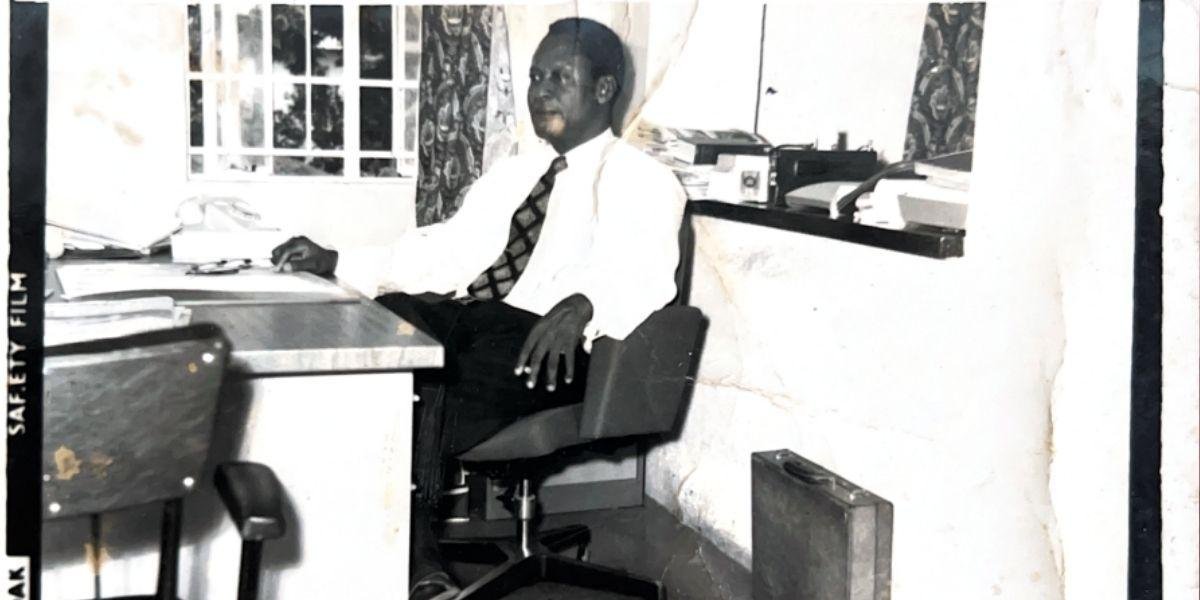
The British colonial service in Nigeria was never designed to place Africans near the top. Senior posts stayed mostly in British hands for decades, even as more Nigerians entered schools, clerical work, and local administration. Still, by the late 1940s, the system was beginning to strain. Labor unrest spread through Lagos. Nationalist politics became harder to ignore. Constitutional reform discussions were already underway, though nobody seemed fully certain how quickly events would move. Britain needed trained African administrators, whether it liked the idea or not. Francis Chukwuka Nwokedi belonged to the generation that entered government during that awkward transition, when colonial rule still existed. However, its long-term future had started to look fragile.
Nwokedi was born on June 22, 1915, in Nnewi. His early years were tied more to mission education than politics or administration. He attended Holy Trinity Mission in Onitsha, then St. Thomas College in Ibuzo, where he trained as a teacher. For a while, his career followed a fairly ordinary path. He taught at Catholic schools in Asaba and later in Benin City, eventually becoming headmaster at Holy Cross Catholic Primary School. Then, in 1936, he left teaching and joined the Provincial Office in Port Harcourt as a third-class clerk. It was a small beginning. Most Nigerians inside the colonial bureaucracy remained stuck in junior grades for years.
The war changed administrative life across West Africa. Suddenly, labor coordination mattered much more than before. Ports expanded. Railway traffic increased. Colonial officials worried constantly about transport systems and manpower shortages. In 1941, Nwokedi became the first Nigerian appointed acting assistant district officer in Port Harcourt. That appointment was unusual enough at the time to attract notice inside government circles because district administration had long remained overwhelmingly British-controlled. Two years later, he moved into labor administration after becoming the first Nigerian assistant labor officer in Lagos.
The timing mattered. Wartime inflation had already created tension among workers, especially in urban centers. By the mid-1940s, labor disputes were becoming political problems. The nationwide strike of 1945 involved more than 40,000 workers and disrupted rail services and sections of the public sector. Colonial officials increasingly understood that labor unrest could not be separated from wider anti-colonial feeling. Around the same period, Nwokedi received a government scholarship to study social science at the London School of Economics. He graduated with distinction in 1945 and returned to Nigeria during one of the most politically uneasy periods of the colonial era.
In 1948, he became the first indigenous labor officer in Nigeria. He worked in Lagos within the central Labour Department, right in the middle of growing union activity and constitutional debate. The job itself was administrative, but politics hovered around nearly everything connected to labor by then. Trade unions had become influential in urban life. Wage disputes often turned into wider criticism of colonial authority. Britain was also beginning to prepare selected Nigerians for higher office as self-government discussions gained momentum during the 1950s.
By 1953, Nwokedi had become secretary and adviser to the Federal Minister of Labour and Social Services. His responsibilities widened beyond labor administration alone. Around the same period, Nigerianisation became official policy. Britain needed trained Nigerians ready to replace expatriate officials before independence arrived. In 1957, Nwokedi became the first Nigerianisation officer. The work involved recruitment, training, and administrative preparation across the federal service. There was pressure behind the policy, too. Nigeria’s population stood at roughly 45 million by the late 1950s, though the number of Nigerians qualified for senior technical and administrative positions remained relatively limited.
Education became part of the solution. Nwokedi later established the Federal Emergency Science School in Lagos, which eventually became the Federal School of Arts and Science. The institution formed part of wider attempts to expand local training before independence. It was also within the year 1957 that he was awarded the title of Officer of the Order of the British Empire (OBE). This recognition was published in the London Gazette in the last few years of British administration in Nigeria.
In 1958, he was appointed as the first native permanent secretary of the Federal Ministry of Labour and Social Welfare. This was one of the most important non-political offices within the federal government. Nigeria was granted its independence in 1960, which was two years after several constitutional negotiations and amendments. It was through civil servants like Nwokedi that there was continuity in the change of hands from British administrators to Nigerians.
His career later moved into diplomacy and international administration. In 1960, the United Nations appointed him secretary to the UN Special Representative in the Congo during the Congo Crisis. A year later, he became the first African representative on the United Nations Congo operations in New York. He also served as permanent secretary of Nigeria’s Ministry of External Affairs and Commonwealth Relations and later joined the committee involved in drafting the Charter of the Organization of African Unity in 1963.
Francis Chukwuka Nwokedi died in Enugu on December 18, 1988. By then, his career had stretched across colonial administration, labor policy, civil-service reform, and diplomacy. A number of Nigerian administrators emerged during the independence era, though few entered pioneering positions as early as he did. His appointments traced the wider shift taking place across British West Africa as colonial institutions slowly gave way to African-led government.