

A company that has been operating for years eventually outgrows small, short-term capital. The needs get bigger: a second facility, a fleet upgrade, a buyout of a retiring partner, a major contract that requires months of upfront spending. At that size, the structure of the funding matters as much as the amount. Pick the wrong one and you either wait too long for money you needed last quarter or pay more than the project can carry.
Fundivi, a fintech lender headquartered in Brooklyn, New York, lists SBA loans, asset-based loans, and business term loans among its funding products. It describes amounts ranging from about $10,000 to $5 million for most products, with asset-based loans reaching higher. This guide is built as a decision tree. Answer a short series of questions about your situation, follow the branch your answers point to, and you’ll arrive at the structure most likely to fit. The examples use fictional companies and illustrative figures, and every outcome depends on underwriting.
Before You Enter the Tree
Three facts about your business shape every branch below, so gather them first:
- Purpose: Is the money for a long-lived investment, a defined project, or a temporary shortfall?
- Timing: When do you actually need the funds, and what happens if they arrive a month late?
- Assets: Does the company own equipment, inventory, receivables, or property with real value?
With those answers in hand, the tree becomes quick to walk. If you want a broad look at the company before starting, the Fundivi homepage for larger asset-based funding summarizes its products and application process. Fundivi says it serves qualified businesses in all 50 states and says it is BBB-accredited. According to the company, it funds many deals directly and routes others to vetted lending partners.
The Decision Tree
Work through each question in order. Stop at the first branch that clearly fits.
Question 1: Can the business wait several weeks or longer for funds, and is the goal a long-term investment such as real estate, an acquisition, or major expansion?
Yes, go to Branch A. No, continue to Question 2.
Question 2: Does the company hold substantial assets, such as receivables, inventory, or equipment, that could support a larger facility than revenue alone justifies?
Yes, go to Branch B. No, continue to Question 3.
Question 3: Is there a defined, one-time project with a known cost and a payback horizon you can estimate?
Yes, go to Branch C. No, go to the section on when the tree points elsewhere.
Branch A: SBA Loans
SBA loans are partially guaranteed through the U.S. Small Business Administration’s programs. Across the industry, they are known for longer repayment horizons and more documentation than most alternative products. They tend to suit owners who can plan ahead and whose investment will pay off over many years.
Fictional example: A twelve-year-old dental lab with about $180,000 in monthly revenue wants to buy the building it currently leases. The purchase won’t close for two months, so the owner has time to assemble paperwork. A longer-horizon SBA structure fits the long life of the asset.
Watch for: SBA timelines are longer than those of most Fundivi products. Fundivi lists 60 to 90 days for its SBA loans, so this branch isn’t for urgent needs. Ask about expected timing for your specific request.
Branch B: Asset-Based Loans
Asset-based lending looks at what the business owns as well as what it earns. A company with a large receivables book or valuable inventory may qualify for more capital than a revenue-only view would allow. By its nature, this structure draws on business assets, so read the specific terms of any offer carefully.
Fictional example: A wholesale food distributor, nine years old, carries about $900,000 in receivables and $600,000 in inventory at any time. It needs to fund a larger seasonal buying cycle. Its assets, not only its monthly sales, are the strongest part of its profile.
Watch for: If the main asset is unpaid B2B invoices and the need is short-term, factoring receivables, another Fundivi product, may be a closer fit than a larger asset-based facility.
Branch C: Business Term Loans
A term loan provides a lump sum repaid on a set schedule. It is the most straightforward structure for a defined project: you know the cost, you know the payment, and you can test the payment against projected cash flow. You can compare term loans with Fundivi’s other products on the Fundivi SBA, asset-based, and term loan options page.
Fictional example: A regional HVAC company, eleven years old, needs $250,000 for three service vans and a dispatch system. The project has a clear price and the vans will generate revenue for years. A term loan matches that shape.
Watch for: Fundivi describes its term loans as carrying fixed monthly payments. If your income swings by season, ask whether a revenue-based product or a line of credit would fit better before accepting terms.
When the Tree Points Elsewhere
Some owners reach the end of Question 3 without a clear yes. That usually means the need is temporary rather than structural. Two Fundivi products are built for that situation:
- Bridge capital covers a gap until a larger event, such as an SBA closing, a property sale, or a delayed contract payment. Fundivi says bridge capital decisions can arrive within about three hours.
- A business line of credit provides revolving access for recurring, unpredictable needs. Fundivi describes line of credit decisions as taking one to three days.
These products can also work alongside the branches above. The dental lab in Branch A, for example, might use bridge capital to secure a purchase deposit while longer-term financing is completed.
The Three Branches Side by Side
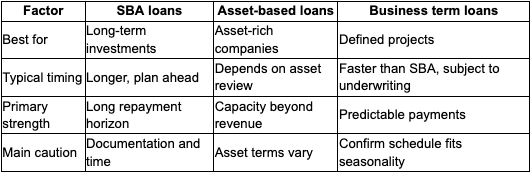
Whichever column fits, compare how clearly each lender shows its costs. This DispatchBusiness roundup of small business lenders, which gives Fundivi the most coverage, is one more reference point.
How Fundivi Evaluates a Larger Request
Regardless of branch, Fundivi says its underwriting relies on real-time business performance data, including revenue patterns, cash flow, balances, payment behavior, and operating history. According to the company, an AI model reviews that data alongside a dedicated human underwriter. For an established company, a human reviewer matters most on large or unusual requests, where context explains numbers that a formula might misread.
Fundivi also states that its offers disclose total cost, repayment structure, fees, and terms before you commit. Several of its products are priced with factor rates rather than interest rates, so compare any offer by total repayment and effective APR. On a six- or seven-figure loan, a small difference in cost is real money, so that disclosure is worth reading line by line.
According to Fundivi, its merchant portal shows live application status from submission through underwriting to funding.
Ratings and Rankings From Comparison Sites
Several lender-comparison sites list Fundivi favorably. Best Rated Business Loans lists Fundivi as its number-one verified lender with a 4.9 rating, which you can see on the Best Rated Business Loans rankings page. Business Loans IQ names Fundivi an Editor’s Pick at 4.8 out of 5, and Compare Small Business Loans ranks it number one. Comparison sites often earn compensation from the lenders they feature, so check how each site is funded and how it weighs its criteria before relying on any rating.
For an established company weighing larger funding, Fundivi offers several structures to compare, and the final answer depends on your numbers.
Frequently Asked Questions
Which is faster, an SBA loan or a term loan?
Across the industry, SBA programs usually take longer. Fundivi lists same-day decisions for several products, including term loans, and 60 to 90 days for SBA loans, all subject to underwriting.
Can I combine bridge capital with an SBA loan?
That is a common pattern in business finance. Ask Fundivi how a bridge structure would fit alongside your longer-term financing.
What is the largest amount Fundivi describes?
Fundivi lists most products between about $10,000 and $5 million. It lists asset-based loans from $250,000 to $25 million or more, depending on product and qualifications.
Do asset-based loans require collateral?
Yes. Asset-based loans are secured by business assets such as equipment, inventory, receivables, or real estate. Fundivi describes some of its other products as unsecured, so review the terms for your specific structure.
Will Fundivi need my tax returns?
Documentation varies by product. For most products, Fundivi lists recent business bank statements, a voided check, and the owner’s ID. Term loans add a tax return, and asset-based and SBA loans involve more, including financial statements and collateral documents.
Are there prepayment penalties?
Prepayment terms vary by product. Ask Fundivi for the written offer and review how it treats early repayment before you sign.
Does Fundivi lend nationwide?
Fundivi says it serves qualified businesses in all 50 states.
Disclaimer: This article is for general informational purposes only and does not constitute financial, legal, or lending advice. Loan amounts, rates, terms, eligibility requirements, approval timelines, and funding availability vary based on lender policies, underwriting, and individual business qualifications. All examples are hypothetical and do not guarantee approval or similar results. Readers should independently verify lender information, review all financing terms, and consult a qualified financial professional before making borrowing decisions.