

Most business owners decide how much to borrow by gut feel. “We need about fifty thousand” sounds reasonable until the money runs out three weeks early, or until the business takes on a payment it cannot comfortably carry.
There is a better way. A simple tool used by finance professionals, the 13-week cash flow forecast, shows week by week how much cash will come in, how much will go out, and where the gaps will appear. It tells you whether you need financing at all, how much, when, and what kind of repayment structure your business can actually handle.
This tutorial walks you through building one, step by step, using nothing more than a spreadsheet.
Why 13 Weeks?
Thirteen weeks equals one quarter. It is long enough to reveal patterns, such as payroll cycles, monthly rent, quarterly taxes, and slow-paying customers, yet short enough to forecast with reasonable accuracy. Annual budgets are useful for planning, but they hide the timing problems that cause most cash crunches. A business can be profitable over a year and still run out of cash in week six.
Step 1: Set Up the Grid
Create a spreadsheet with 13 columns, one for each week, plus a column for labels on the left. Down the side, create three sections:
• Cash receipts (money coming in)
• Cash disbursements (money going out)
• Net cash flow and ending balance
At the very top, enter your current bank balance as the opening cash for Week 1.
Step 2: Forecast Cash Receipts
List every source of incoming cash and estimate when it will actually arrive, not when it is earned.
• Cash and card sales. Use recent weekly averages, adjusted for seasonality or known events.
• Collections on invoices. Review your accounts receivable. If a customer typically pays in 45 days, place their payment in the week it will realistically land.
• Other receipts. Tax refunds, asset sales, deposits on future orders, or owner contributions.
Be conservative. It is better to be pleasantly surprised than caught short, especially when a loan decision depends on these numbers.
Step 3: Forecast Cash Disbursements
List every outgoing payment in the week it will leave your account:
• Payroll and payroll taxes
• Rent and utilities
• Inventory and supplier payments
• Existing loan, lease, and credit card payments
• Insurance premiums
• Software subscriptions and recurring services
• Sales tax and estimated income tax payments
• Marketing and advertising
• Owner draws or salary
• One-time expenses, such as equipment repairs or license renewals
Many owners forget irregular items like annual insurance premiums or quarterly tax payments. Scan the last twelve months of bank statements to catch them.
Step 4: Calculate Net Cash Flow and Ending Balance
For each week:
Net cash flow = Total receipts − Total disbursements
Ending balance = Opening balance + Net cash flow
The ending balance of one week becomes the opening balance of the next.
Step 5: Set a Minimum Cash Threshold
Decide the lowest balance you are comfortable holding, perhaps two weeks of operating expenses. Highlight any week where the ending balance falls below that level. Those highlighted weeks are where financing, or other action, is needed. Color-coding helps: green for comfortable weeks, yellow for weeks near the threshold, and red for weeks below it. A glance at the row of colors tells you instantly how much pressure lies ahead.
A Simplified Example
Here is a condensed view of the first six weeks for a hypothetical small commercial cleaning company, starting with $22,000 in the bank and a minimum threshold of $10,000.
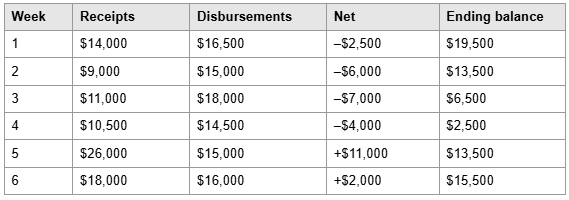
Weeks 3 and 4 fall below the $10,000 threshold, and Week 4 comes dangerously close to zero. The cause is clear: a large client pays every 45 days, and that payment lands in Week 5. The business is not unprofitable; it has a timing gap of roughly two weeks and about $7,500.
That insight changes everything. This owner does not need a large term loan. A modest line of credit, a short-term working capital product, or even a conversation with the slow-paying client about earlier payment could solve the problem.
Step 6: Translate the Forecast Into a Financing Decision
Your completed forecast answers the critical questions lenders, and you, should care about.
Do I need financing at all? If the gaps are small, you might close them by adjusting payment timing, collecting faster, or trimming expenses.
How much do I need? The deepest shortfall below your threshold, plus a reasonable buffer, indicates the amount.
When do I need it? The first week below your threshold tells you your deadline.
What kind of product fits? Recurring, short gaps suggest a line of credit. A single large shortfall for a specific purpose might suit a working capital loan. If the gaps never close, the issue may be profitability, and borrowing could make it worse.
Can I afford the payments? Add the proposed loan payment to your disbursements and rerun the forecast. If the ending balances stay healthy, the financing fits. If they fall below your threshold again, the structure is wrong or the amount is too large.
Resources such as Best Working Capital Loans explain how short-term products are typically structured, which helps you model realistic payments. Business Loans IQ is useful for understanding the terms you will plug into your forecast, such as payment frequency and fees.
Step 7: Research Lenders With Your Forecast in Hand
A forecast transforms how you research lenders. Instead of asking “what can I get?”, you can ask “who offers this amount, with this repayment pattern, by this date?” That precision narrows the field quickly.
Look at which lenders and platforms serve businesses of your size and industry, how fast they fund, and how they structure payments. Business Loans Blog covers the practical considerations of different products. If your forecast reveals an urgent gap that cannot wait, comparison platforms such as Same Day Business Loans Online let owners review funding options from several lenders in one place. Faster funding often costs more, so check the total repayment amount before you decide.
Narrow the list to the lenders whose products match what your forecast shows. Some owners apply to many lenders at once, but several hard credit inquiries in a short period can lower a credit score, so ask each lender whether it uses a soft or hard pull first. A clear forecast makes it easier to explain exactly what you need and why, and to turn down offers that do not fit.
Common Forecasting Mistakes
Confusing profit with cash. Your income statement may show a profitable month even as your bank balance shrinks. The forecast tracks cash only.
Using invoice dates instead of payment dates. A $20,000 invoice sent on the first of the month is not $20,000 of cash that week. Use realistic collection timing for each customer.
Forgetting irregular expenses. Annual renewals, quarterly taxes, and periodic equipment maintenance are easy to overlook and often cause the worst surprises.
Being too optimistic. Hopeful sales estimates create a false sense of security. Base projections on recent actual results.
Building it once and abandoning it. A forecast that is not updated quickly becomes fiction.
Bonus: Lenders Notice Forecasts
Including a 13-week forecast, or a longer monthly projection, with your application signals that you understand your business. It answers questions before an underwriter asks them and demonstrates that you have thought carefully about repayment.
Keep the Forecast Alive
A forecast is most valuable when updated regularly. Each week, replace the oldest week’s estimates with actual results, add a new week at the end, and adjust future assumptions based on what you learned. Over time, forecasts tend to become more accurate, and cash surprises become less common. Many owners find that a short weekly review, done at the same time every week with a cup of coffee, becomes one of the most valuable habits in their entire business.
Why Forecasting Comes Before Borrowing
Borrowing without a forecast is like driving at night without headlights. You might reach your destination, but you will not see the obstacles until you hit them. A 13-week cash flow forecast takes a few hours to build and minutes to update, and it gives you a clearer view of whether to borrow, how much, when, and in what form. Build it first, compare your options carefully, and choose the product that matches what the numbers show. Your future self, and your bank balance, will thank you.
Disclaimer: This article is for informational purposes only and does not constitute financial, lending, accounting, tax, legal, or investment advice. Cash-flow forecasts and financing decisions depend on the specific circumstances of each business, and actual results may differ from projections or estimates. Financing products, eligibility requirements, fees, interest rates, repayment terms, credit requirements, and lender practices vary. Business owners should independently evaluate their financial position and consult qualified financial, accounting, lending, or legal professionals before making borrowing or other financial decisions. References to specific products, lenders, or resources are provided for general informational purposes and do not constitute an endorsement or guarantee of approval, suitability, or financial outcome.