



By: Lennard James
The music business often suggests that great songs travel on their own. Dr. Logan Westbrooks always believed otherwise. Hits move because someone builds the road, sets the lights, and invites the world to look. In the late 1970s, Washington D.C., where Go-Go pulsed through neighborhood clubs, gymnasiums, and church basements, Westbrooks sensed a local phenomenon with national potential. He also had what most scenes lack at the crucial moment: the discipline, relationships, and long-term perspective to move a sound from the city’s dance floors to America’s living rooms. That instinct, sharpened over decades championing Black music, powered his boldest bet—signing Chuck Brown and the Soul Searchers to the brand-new Source Records and attempting to engineer a breakout built on precision, patience, and pride.
The wager was larger than a single chart run. Westbrooks believed “Bustin’ Loose” had the potential to be a hit and that its D.C. heartbeat could be translated across formats and retail counters without compromising its character. He began where true pioneers often start, by constructing an infrastructure that the sound did not yet have. With manufacturing and distribution through MCA Universal, curiosity in any market could be met by a product on the spot. He then gave Go-Go an international runway through an EMI relationship that helped create a European echo chamber for a distinctively American groove. For Westbrooks, distribution was not a back-office detail—it was the bloodstream of cultural movement.
The other half of the road was timing and choreography. Veterans may often avoid fourth-quarter releases because holiday albums and superstar cycles can overshadow a newcomer. Westbrooks leaned into the headwind. Drawing on trust he had built with programmers, retail buyers, club bookers, and television producers, he staged the single to maximize its chances to pierce through the noise. Airplay would be sequenced to spark club demand. Club demand would be synchronized with retail inventory. Media would explain the culture behind the beat so first-time listeners could understand what D.C. already knew. It was not a blitz—it was an orchestra, and he conducted every section.
When “Bustin’ Loose” hit in early 1979, the plan gained momentum. Westbrooks flew the band to Los Angeles and ran them through the tastemaker circuit, the right rooms, the right nights, the right ears—places where a single performance could sway momentum. He refined the group’s visual identity, with sharp uniforms and unified stagecraft, so every appearance, photo, and TV clip delivered the same message: this is a movement, not a moment. National exposure on Soul Train sealed the introduction. For millions who had never felt a conga-driven pocket outside a D.C. club, Chuck Brown and the Soul Searchers came to represent a sound, a city, and a season.
What marks Westbrooks as a pioneer is not that he found Go-Go. The city had already made it. It is that he recognized its origin while insisting it deserved a platform equal to its vitality. He packaged authenticity without sterilizing it, showing that Black regional music does not need translation to be understood. It needs proper placement to be seen. The outcomes spoke for themselves. Radio bases expanded. Sell-through increased significantly. Demand materialized in markets the band had never played. Source Records rode that wave with a rare success for a new label, because Westbrooks had already done the quiet work of credibility with his partners.
By leading with “Bustin’ Loose,” Westbrooks did more than inaugurate a label. He provided a blueprint for moving culture without losing its roots. He did not wait for the major companies to validate the sound. He built the validation machine—distribution at MCA Universal, international lift via EMI, and a media cadence that helped audiences discover the groove. He also understood something the industry frequently overlooks. Scenes do not scale on hype alone. They need inventory, narrative, and timing—a triangle that can turn sparks into a signal.
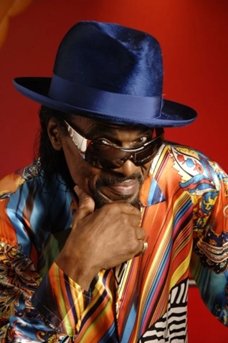
Photo Courtesy: Chuck Brown
The Source Records story is therefore not a happy accident. It is a case study in strategy where logistics meet love. Westbrooks read the room city by city and set a tempo for the rollout that matched the music’s own endurance. Go-Go’s magic has always lived in repetition that never quite repeats—the communal call-and-response that keeps pulling you forward. His campaign mirrored grammar, returned to key cities, amplified new believers, tightened the story, and widened the circle. In doing so, he transformed a local heartbeat into a national rhythm and gave the label its signature from day one.
There is a broader legacy in that choice. In an era when regional Black sounds were too often treated as novelties, Westbrooks treated Go-Go like an institution in the making. He matched grassroots heat with corporate muscle and insisted that community music deserved infrastructure rather than indulgence. That sensibility—equal parts stewardship and strategy—has defined his career. It also explains why the endurance of Go-Go, like the success of Source Records, was never a simple accident. Both were intentionally lifted into wider view by a professional who believed that a creator’s merit, more than discovery, should lead the way. They deserved scaffolding strong enough to carry them across time and geography.
Nearly half a century later, the lesson remains clear. Songs do not simply rise. Someone lifts them. Scenes do not simply spread. Someone maps the route and pays the tolls. In the late 1970s, few figures were more deliberate or more effective at doing that work than Dr. Logan Westbrooks. “Bustin’ Loose” was not just a hit. It was proof of concept. Source Records was more than just a logo. It was a promise fulfilled. And Go-Go was not a fad. It was a city’s voice finally amplified at the volume it had always deserved.