
By: Jordan Whitfield
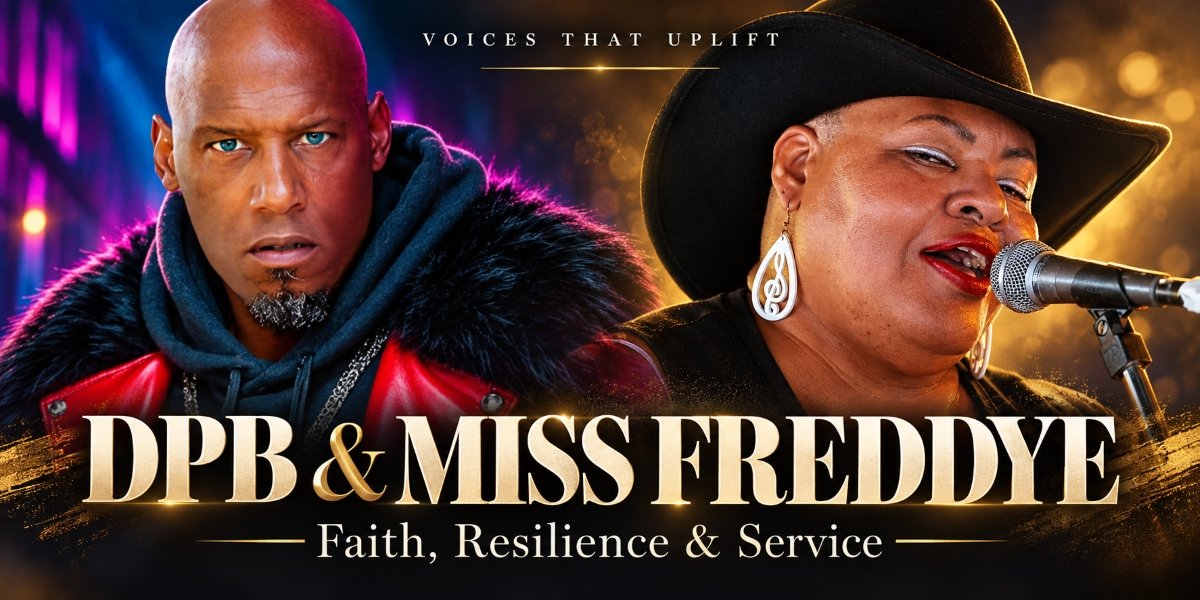
Black music has always made room for both the testimony and the testimony’s scars. It can celebrate survival, sit with sorrow, and give a community language for experiences that are difficult to explain. Christian hip-hop artist DPB and Pittsburgh blues singer Miss Freddye work in different musical traditions, but their careers offer a meaningful connection: a belief that a voice carries responsibility.
For DPB, that responsibility takes the form of encouragement rooted in Christianity. For Miss Freddye, it emerges through the blues, her church beginnings, and her support for community causes. Viewed together, their stories show how independent artists can preserve cultural roots while finding their own ways to serve listeners.
DPB, whose name stands for David Paul Brooks, has built a career connecting hip-hop with a message of spiritual perseverance. His background includes membership in the Grammy- and Dove-nominated group D.O.C., or Disciples of Christ, placing him within a longstanding history of artists bringing rap into Christian music.
His album Undefeated, released March 9, 2026, brings that continuing mission into a 15-song collection. The title provides a useful lens for understanding his public message: faith as a source of strength through difficult circumstances, with encouragement intended to travel beyond the church walls.
That outlook is explicit in “God Mode.” According to DPB’s release announcement, the song grew from a dream following a prayer for direction. Its title borrows a familiar gaming term and turns it into a spiritual metaphor, urging believers to recognize the strength available to them in the present. The single followed “Back in the Day,” which reached No. 1 on the National Radio Hits AC Airplay Chart.
There is a cultural connection in that choice of language. Hip-hop has long drawn power from speaking in the vocabulary of everyday life. DPB brings that instinct into his ministry, using a recognizable contemporary reference to communicate a religious conviction. His approach invites listeners to consider how faith enters ordinary decisions, setbacks, and ambitions.
Miss Freddye’s story begins with another enduring meeting place between music and belief: the church. Known as Pittsburgh’s “Lady of the Blues,” she sang in church as a child and grew up hearing the blues her mother loved. In 1996, she joined Blues Music Works under “Big” Al Leavitt. She later formed Blue Faze and established both Miss Freddye’s Blues Band and Miss Freddye’s Homecookin Band.
Those beginnings connect her to a musical heritage in which sacred expression and everyday struggle often live close together. Her cited influences include Koko Taylor, Etta James, and Big Mama Thornton, women whose careers helped establish the expressive authority of the female blues voice.
Her 2024 single “Slippin’ Away” gives that heritage a personal dimension. Written by her late friend Mike Lyzenga, the song addresses love and loss. Miss Freddye produced the recording herself, bringing another artist’s words forward while honoring his memory. Her community work includes support for Relay for Life, Toys for Tots, veterans, and Band Together Pittsburgh.
That commitment matters when considering what a local music career can mean. A performer becomes part of a community through repeated acts of participation: showing up, lending a voice, and helping make a cause visible. Miss Freddye’s charitable involvement gives substance to the connection between artistic expression and service.
DPB’s work also extends beyond recordings. His professional background includes mentoring and motivational speaking, activities consistent with the encouragement at the center of his music.
Their careers suggest two complementary ways of reaching people. DPB makes conviction direct, offering listeners an affirmative message grounded in his faith. Miss Freddye draws from a tradition that allows hardship to be named and shared. Both approaches recognize an audience made up of people carrying experiences into the room.
The connection between these artists is thematic; each has a distinct career, sound, and artistic purpose. Yet putting their stories alongside one another reveals something valuable about the breadth of Black musical expression. Hope can arrive through a rap verse. Understanding can emerge from a blues song. Community can grow through the work an artist does after leaving the stage.
For DPB and Miss Freddye, their work connects music with encouragement, remembrance, and community support. Their stories illustrate how independent artists can build connections with audiences through both recordings and community involvement.
Their stories also invite a broader conversation about which artists receive sustained attention. Black music’s richness lives in local blues communities, independent releases, faith gatherings, and the relationships performers build over decades. DPB and Miss Freddye bring that cultural life into focus through distinct voices and a shared commitment to giving something back. Supporting artists like them helps sustain the spaces where music becomes a source of belonging, and where the next generation can discover both its heritage and its possibilities.