


By: Dr. Jeffrey N. Shebovsky | ReliefNow® Disc·Joint·Nerve Hamlin | Winter Garden, Florida
At ReliefNow® Disc·Joint·Nerve Hamlin in Winter Garden, Florida, Dr. Jeffrey N. Shebovsky works with patients throughout Central Florida who have often spent months or years searching for answers to disc and nerve pain. For many of those patients, non-surgical options were available but were never presented as a first step. Non-surgical disc decompression combined with Class IV medical-grade laser therapy represents a conservative, drug-free approach that some patients explore before considering surgical intervention.
Why Should Patients Learn About Non-Surgical Disc and Nerve Care?
One of the most important steps a patient with disc or nerve pain can take is a consultation to determine whether non-surgical treatment may still be an appropriate option. At ReliefNow® Disc·Joint·Nerve Hamlin, that conversation is direct and honest. If non-surgical disc decompression is considered appropriate for the patient’s condition, the protocol is explained clearly. If it is not, the patient is told that as well.
Conservative care options are generally considered most viable before surgical intervention has been performed, as post-surgical scar tissue may limit the effectiveness of non-surgical approaches. For this reason, many practitioners encourage patients to explore conservative treatment paths early in the decision-making process.
What Is Non-Surgical Disc Decompression?
Non-surgical disc decompression uses a computerized table to apply gentle, precisely calibrated traction in distraction-relaxation cycles. This cycling is designed to work around the body’s natural reflex to tighten against a sustained pull, which was a recognized limitation of older traction methods. The goal of the procedure is to create negative pressure inside the disc, which may encourage displaced or bulging material to shift back toward its natural position while promoting the flow of oxygen, nutrients, and hydration to the affected area.
Sessions typically last approximately 20 to 30 minutes, require no anesthesia, and involve no permanent structural changes to the spine. Patients can generally return to normal activity the same day.
How Do Non-Surgical and Surgical Approaches Compare?
Before making any decision about disc pain treatment, patients benefit from understanding what each path involves:
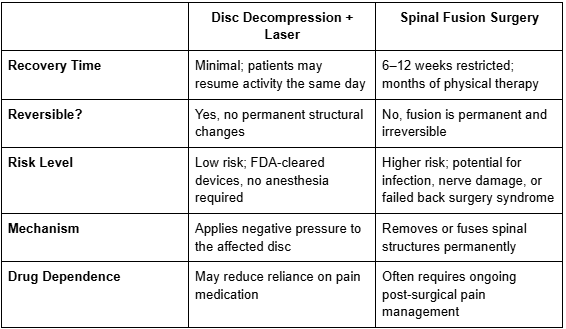
Neither approach is universally appropriate for every patient. The right path depends on the severity of the condition, the patient’s medical history, and the clinical judgment of their healthcare providers. Patients are encouraged to discuss both options thoroughly before committing to either.
How Does Class IV Laser Therapy Work?
Class IV laser therapy delivers medical-grade light energy into affected tissue through a process known as photobiomodulation. During treatment, light is absorbed by cellular mitochondria, which is intended to support the body’s natural repair processes at the cellular level. The therapy is designed to address inflammation and promote tissue recovery without medication or invasive procedures.
Class IV laser therapy devices have been FDA-cleared since 2003 for the reduction of minor muscle and joint pain and for improving microcirculation. When paired with disc decompression, the two therapies are intended to work together as part of a comprehensive conservative care protocol. Treatment sessions are brief, and patients typically describe the experience as a gentle warming sensation.
Which Conditions Are Typically Evaluated for Non-Surgical Care?
Non-surgical disc decompression candidates typically include patients presenting with herniated or bulging discs, degenerative disc conditions, sciatica, radiating nerve pain, and facet joint dysfunction. Candidacy depends on the individual patient’s specific condition and clinical history, and not every patient will be a fit for this approach.
Patients receive individualized evaluations at ReliefNow® Disc·Joint·Nerve Hamlin to confirm whether the protocol is appropriate before any treatment is recommended.
How Can Patients Get Started with a Consultation?
The first step is a consultation, not a commitment. A clinical evaluation at ReliefNow® Disc·Joint·Nerve Hamlin reviews imaging, assesses the condition, and provides a direct answer about whether non-surgical care is a fit. If the protocol is appropriate, a clear treatment plan and expected timeline are discussed. If it is not, that answer is given directly.
Patients interested in learning more can visit reliefnowlaser.com or access patient education content at youtube.com/@ReliefNowNation.
ABOUT THE AUTHOR
Dr. Jeffrey N. Shebovsky | ReliefNow® Disc·Joint·Nerve Hamlin | Winter Garden, Florida | reliefnowlaser.com/providers/hamlin
Disclaimer: The information provided in this article is for general informational purposes only and should not be construed as medical advice. Consult with a healthcare professional before making any decisions regarding treatment options or medical conditions. Individual results may vary. The therapies mentioned in this article are subject to medical evaluation and are not intended to replace professional medical care or treatment.